- Integration overview
- Integration steps
- 1. Generate an API token
- 2. Create an XML feed
- 3. Configure Indeed Apply for your jobs
- 4. Add Indeed Apply screener questions
- 5. Receive application data from Indeed
- 6. Test your Indeed Apply configuration
- 7. Monitor integration health
- 8. Submit your XML feed for review
- 9. Send disposition data to Indeed
Indeed Apply integration guide for ATS partners
Integrate with Indeed Apply for applicant tracking system (ATS) partners.
- By using this API and its documentation and building an integration, you agree to the Additional API Terms and Guidelines.
Integration overview
These instructions help Indeed applicant tracking system (ATS) partners integrate with Indeed Apply.
When you integrate your ATS with Indeed, your clients can enable Easily apply on their job posts and send applicants to their ATS. Indeed Apply improves the job seeker experience and helps your clients hire faster.
Before you integrate, sign a Developer Agreement with Indeed. To integrate your ATS with Indeed Apply, you need:
- A signed Developer Agreement between your company and Indeed. Submit every integration build through the formal request channel on Become an Indeed partner.
- A software developer who knows your systems and HTTP, XML, and JSON.
- A way to publish and refresh the XML feed you build, such as FTP.
- A way to publish screener questions to an HTTPS URL.
- An Indeed Apply API token.
The process usually takes about six weeks to configure, test, review with Indeed, and deploy for client adoption.
For an XML integration, publish an XML feed to Indeed on a regular schedule. The feed controls how key job details appear on Indeed. To enable Indeed Apply on Indeed.com, add metadata to each job. That metadata shows screener questions in the Indeed Apply flow and tells Indeed where to send candidate information.
After you add Indeed Apply metadata and any optional screener questions, Indeed reviews the feed for technical quality and policy compliance.
Work with the Indeed Integrations Delivery team to choose how you publish and update the feed, and to review Indeed's feedback and required fixes.
Integration steps
1. Generate an API token
When you become an Indeed partner, Indeed creates an app that connects Indeed APIs and services to your product. To view the app and its Indeed Apply API token credentials, a client ID and secret, sign in to Partner Console. Include this API token in each job you post to Indeed.
2. Create an XML feed
To configure Indeed Apply for your ATS, create and maintain an XML feed. This XML document defines your jobs and how they appear on Indeed.
When your customers create job listings in your system, the XML feed sends those listings to Indeed.
An XML feed includes:
| Item | Defines |
|---|---|
Basic feed nodes | General feed details, including the XML version, encoding, and ATS information. |
Job feed elements | Job-specific details. Include one set for each job that appears on Indeed. |
If you create a job through either the createSourcedJobPostings mutation or an XML job feed, expiration of the job requires an action on your part. You must explicitly expire that job.
Even if someone calls the updateSourcedJobPostings mutation or clicks Edit on the Indeed job details page for this job, you must explicitly expire that job.
See also:
createSourcedJobPostingsupdateSourcedJobPostings- Job details page (signed in to Indeed)
- Job Sync XML feed reference
See the Job Sync XML feed reference.
3. Configure Indeed Apply for your jobs
To let job seekers apply quickly from Indeed, enable Easily apply with Indeed Apply.
Jobs with Easily apply get 12% more clicks. Job seekers can also apply with their Indeed Resume.
To configure Indeed Apply for your jobs:
- Add Indeed Apply configuration parameters to an
<indeed-apply-data>element for jobs in your XML feed. - Set
postUrlin<indeed-apply-postUrl>so your system can accept applications from Indeed. - Make sure your system can parse and handle the application data.
For configuration parameters, see Indeed Apply configuration parameters.
For the <indeed-apply-data> element, see the XML feed with <indeed-apply-data> example.
For more about Easily apply, see Policy - Indeed Apply and What does easily apply mean?
4. Add Indeed Apply screener questions
Screener questions help employers quickly see whether applicants meet their criteria, so they can spend more time connecting with candidates.
Indeed does not host screener questions for you. If your system supports them, you must implement them in Indeed Apply for your integration to be approved.
To show screener questions in the Indeed Apply flow, you can either:
-
Format them in JSON and host them at an HTTPS URL. Put that URL in each
<job>with<indeed-apply-questions>under<indeed-apply-data>.For details, see the Indeed Apply configuration reference.
-
Call the Job Sync API to create a job posting with screener questions.
In January 2024, Indeed added schema versions for screener question configuration. Indeed updates the minor version when it adds features. The application payload shows the version as 1.X, such as 1.1 or 1.2. Keep this value flexible so major or minor upgrades do not break your integration. Your screener question JSON does not need to match the minor schemaVersion.
Considerations
-
You can ask up to 500 questions.
Conversion drops sharply when you ask more than 20 questions.
-
Question files can be up to 1 MB.
-
Indeed caches question files for unique question URLs and refreshes them every 24 hours, or sooner if a new request arrives after the cache is more than one hour old.
-
If you change the JSON at a question URL, or add resume standardization, switch to a new URL to clear the cache.
-
Indeed does not allow employers to request unnecessary personally identifiable information (PII) in a job description or during the application process. For more information, see Policy - Personally Identifiable Information (PII).
When a job seeker starts Indeed Apply and Indeed requests questions, Indeed caches those questions.
JSON for screener questions
For parameter lists and examples of question types, see Screener questions.
5. Receive application data from Indeed
To receive application data from Indeed, specify a URL in the feed for each job. Indeed sends candidate information for that job to this URL as JSON.
Application delivery
To process applications programmatically, specify a URL that accepts POST requests from Indeed Apply.
The <indeed-apply-postUrl> parameter defines this URL. It must use HTTPS.
postUrl example
indeed-apply-postUrl=https%3A%2F%2Fyourposturl.comReturn an HTTP 2XX status code for every application your system receives successfully. Indeed Apply treats any other HTTP status code, POST timeout, or connection timeout as a failure.
If Indeed does not receive an HTTP 2XX because of a timeout or invalid response, it retries with exponential backoff. If delivery still fails after the last retry, Indeed marks the application as a terminal failure.
Do not validate application content during the POST. If you want to validate the content and disqualify the applicant, do that after the POST. If partner-side validation causes HTTP failures for job seeker data, Indeed might disable Indeed Apply for that company or for the entire feed.
See the Application delivery reference.
Do not redirect the POST to another URL, such as with a 301 or 302 response. Indeed Apply does not support redirects.
Duplicate applications
When you respond to the POST, treat an application as a duplicate only if both of these are true:
- It uses the same job ID.
- It uses the same job seeker email address as an Indeed application from the last 120 days.
Do not consider applications from other sources when you check for duplicates. Do not treat an application as a duplicate if the same job seeker email applies to a different job ID at the same company.
Application data
Indeed sends application data in the raw body of the HTTP POST, so you cannot process the request like a typical form. Read and parse the JSON in the request body. Indeed does not send every JSON field in every request, so use a parser that treats missing fields as empty and ignores unrecognized fields.
A JSON payload has no maximum size.
The POST body uses UTF-8 encoding and includes an authenticity header that helps you verify that Indeed sent the application.
The file section of the Applicant field contains contentType, data, and fileName.
Indeed determines contentType from fileName.
The data field contains the raw resume file in Base64 encoding.
Your system must support these file types: .txt, .pdf, .doc, .docx, and .rtf.
If your system already stores a version of the resume, you must still store and use the updated version from the application JSON.
For application data details, see the Application data reference.
Authentication of the POST request
Indeed Apply sends a POST request to your postUrl with an HTTP header you can use to verify that the POST is authentic.
Indeed uses the shared API secret for the Indeed Apply credential type and computes a message signature with HMAC-SHA1. Indeed sends this signature in the X-Indeed-Signature header.
To generate signatures, Indeed Apply uses the full unaltered JSON payload, including the curly braces ({}), and the shared secret.
For code examples of how Indeed generates the message signature, see the Message signature generation reference.
Supported SSL certificates
For supported certificates, see Trusted root SSL certificates.
If your certificate is not listed, contact the Integrations Delivery Team.
6. Test your Indeed Apply configuration
Indeed provides tools to test the components of your Indeed Apply integration. Review these topics to find the available tools and fix integration issues early.
Test Indeed Apply application flow and applicant delivery
Before you launch a job or integration, test your setup with the Apply XML configuration testing tool.
Enter your Indeed Apply XML metadata for a job, or let the tool generate it from configurable parameters. The tool flags formatting and content errors so you can find issues quickly.
If it finds no errors, it shows Start testing. Select it to review the application experience and submit a test application. If your postUrl is valid, the tool sends a test application payload to that URL. Use it to confirm that your system parses the JSON and shows applicant information as expected.
Test your Indeed Apply XML metadata
The first tab of the Indeed Apply XML configuration testing tool lets you enter Indeed Apply metadata from XML and review it in the application flow. The Configuration section lists every parameter in the XML so you can see your detected job elements.
For the supported parameters, see the Indeed Apply configuration reference.
Indeed Apply XML configuration testing tool - XML tab
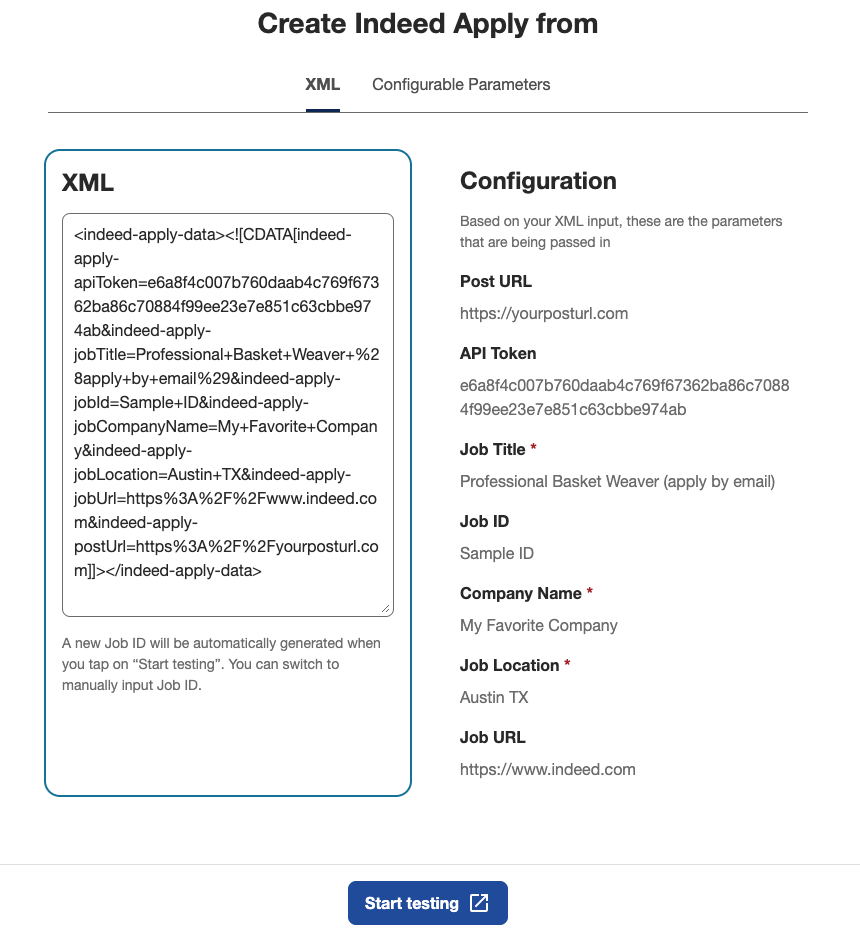
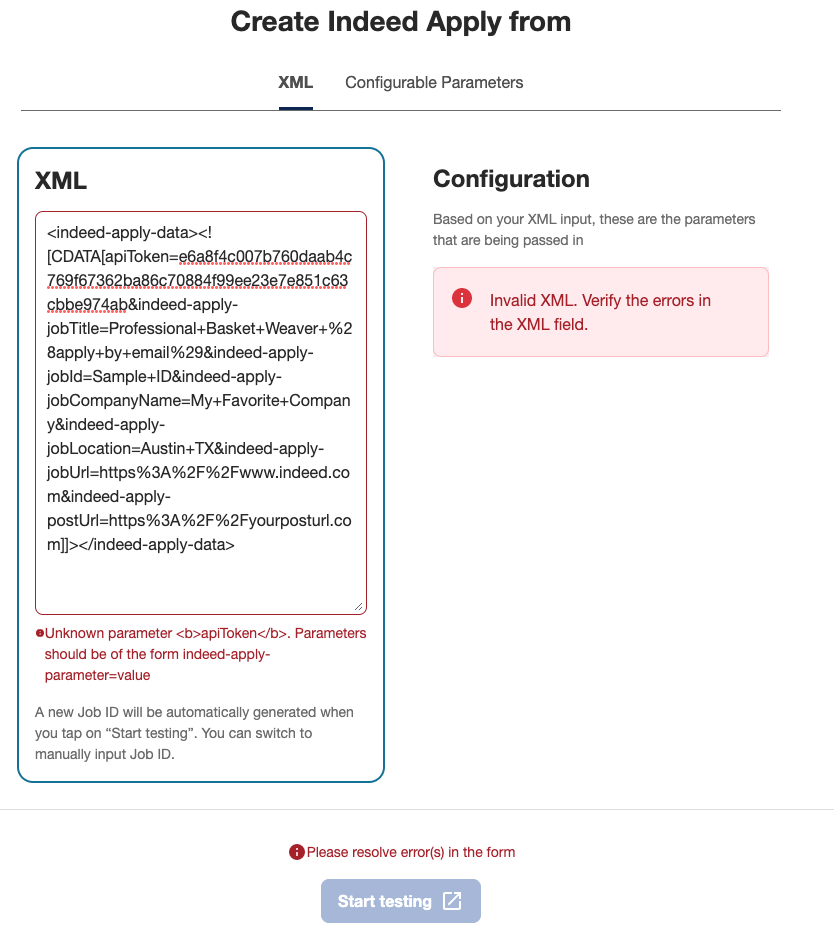
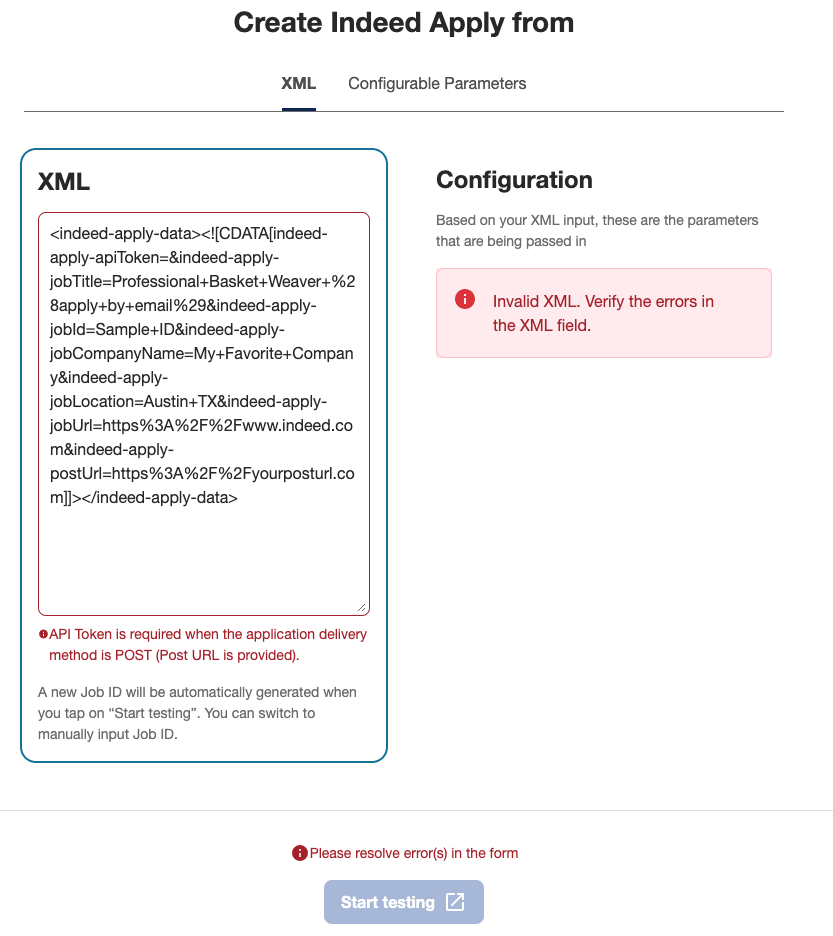
The tool also flags metadata errors that can break Indeed Apply, such as a missing required parameter or an incorrectly formatted file. In either case, the tool shows an alert.
Example: Incorrect parameter format error
Example: Missing parameter error
The second tab lets you fill in configurable parameters and generates the matching Indeed Apply XML metadata. You can also preview how the job appears in the application flow.
After the tool generates the metadata, add it to your XML feed. For an example, see Create an XML feed.
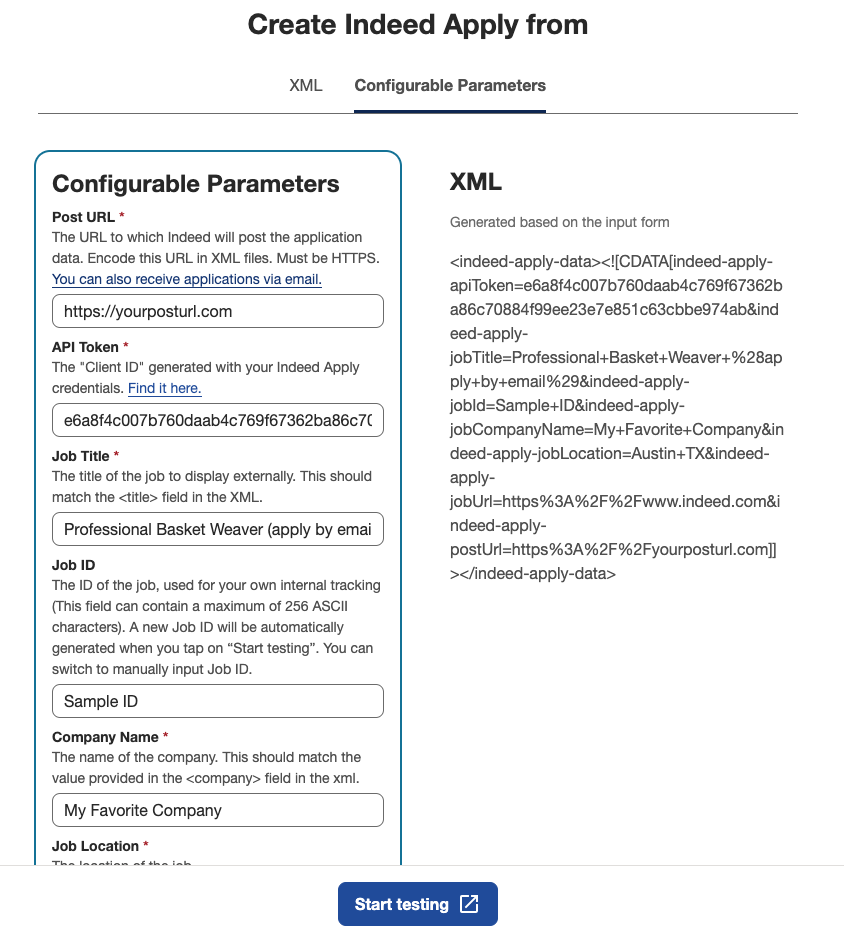
Indeed Apply XML configuration testing tool
Beyond the default parameters, you can add more from a list of options. After you select and fill them in, the tool adds them to the generated XML.
This tool lets you mock up your Indeed Apply integration. Provide your postUrl in the Indeed Apply tags to walk through the application experience and post the application to that URL with the tool's sample data.
Test your Indeed Apply screener questions
Use the Indeed Apply Questions tool to check the syntax of your screener questions JSON and see how the questions appear in the Indeed Apply flow.
Indeed Apply Questions tool
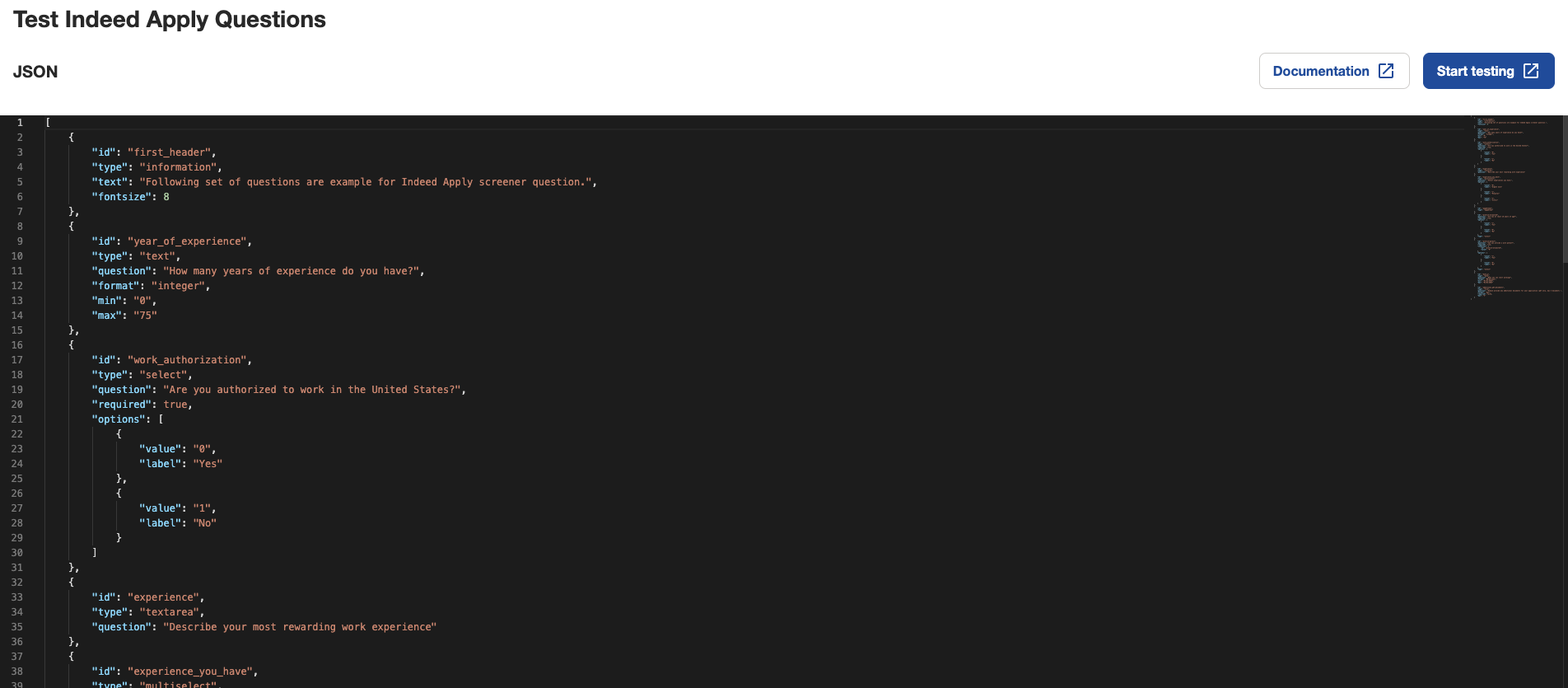
Paste your entire JSON file into the main field to highlight formatting errors.
Error message examples

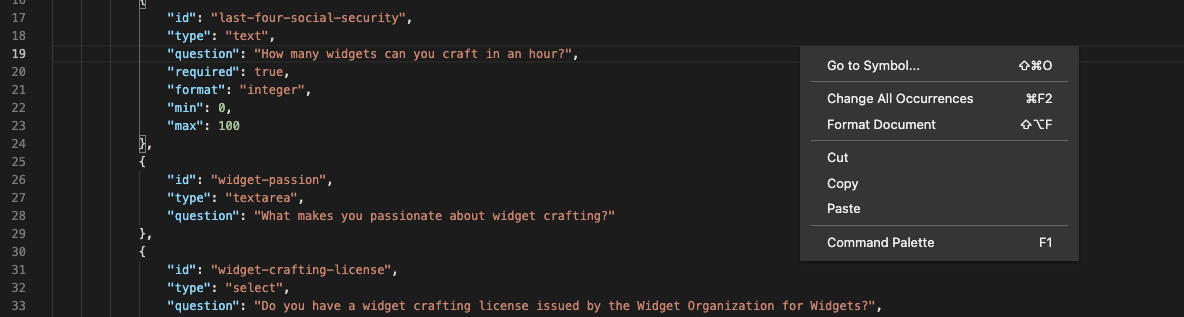
Right-click in the editor to run basic text commands.
Basic text commands
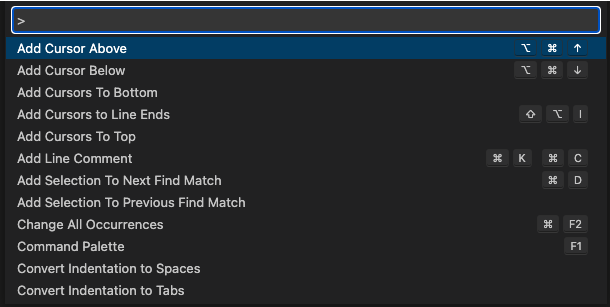
For more advanced commands, such as those in VS Code, open the Command Palette or press F1.
More advanced commands
The tool includes a link to this documentation so you can review JSON parameters when needed.
After your JSON is formatted correctly, select Start testing to preview how your screener questions appear to job seekers.
7. Monitor integration health
When you integrate with Indeed Apply, set up monitoring to verify that:
- Your integration delivers job applications successfully.
- Your question files are valid and always available.
Indeed also monitors application delivery to agency and third-party platforms, along with other health indicators. If problems occur, Indeed might contact you, and can disable Indeed Apply for some or all job listings in your feed until you fix the issues.
Undelivered applications are not lost. If delivery fails, Indeed retries at regular intervals after the original submission. If delivery still fails, Indeed keeps applications for 60 days. To request more retries, contact the Integrations Delivery Team.
If your integration supports screener questions, verify that the pages hosting those files stay available, do not redirect, and use the correct format.
8. Submit your XML feed for review
After development, submit your XML feed to your technical point of contact for review, or request support through Partner Console.
9. Send disposition data to Indeed
Disposition data describes updates to an application in your ATS.
An update is any change in a recruiter's workflow, or any action a recruiter or candidate takes after the candidate applies, such as hiring the candidate.
Sending disposition data to Indeed improves application quality for your clients over time.
See the Disposition Sync API Guide.